 Saddle
Keep your booking system. Add the part it’s missing.
The owner most ready to build something is not the one with no software. It is the one paying a monthly fee for software that does most of the job, and doing the rest by hand — because the missing piece is never coming.
Why the notes field is the answer you keep getting
You chose the tool, you pay for it every month, and it covers most of what you do. The part it misses is small and specific: which clients want which products, which building needs which door code, which price depends on the size of the animal. You ask support. Support tells you to put it in the notes field. You ask again a year later and it still is not there — not because it is hard, but because you are not who they built it for.
“they never add it because you’re not their target market”
Where it goes wrong
- The one thing you actually need is the thing it won’t do
- Real operating detail — allergies, access codes, who must not be booked next to whom — ends up in a notes field nobody can sort, count or search. Which means it ends up in your head.
- Switching costs more than the gap
- You have tried the alternatives and they each miss something different. Moving years of history to fix one gap is a bad trade, so you stay, and you keep doing that part by hand.
- The workaround is you
- The missing piece costs the same hour every month, and it is an hour nobody can take off you, because the rule only exists in your head.
What the page actually has to do
- Something small, beside what you keep
- Not a replacement. One page that does the missing part, on its own link, while your booking system carries on doing what it is good at.
- Your fields, your rules
- The ones no vendor is going to add for you: eco products only, dog in the house, gate at the back, invoice goes to the landlord not the tenant.
- A link you can hand to staff or to a client
- It opens in the browser on their phone. Nothing to install, and no account unless you want one.
- Yours to change when the business changes
- Say what changed in plain words and the app changes. You are not filing a feature request and waiting a year.
Something like it, already running
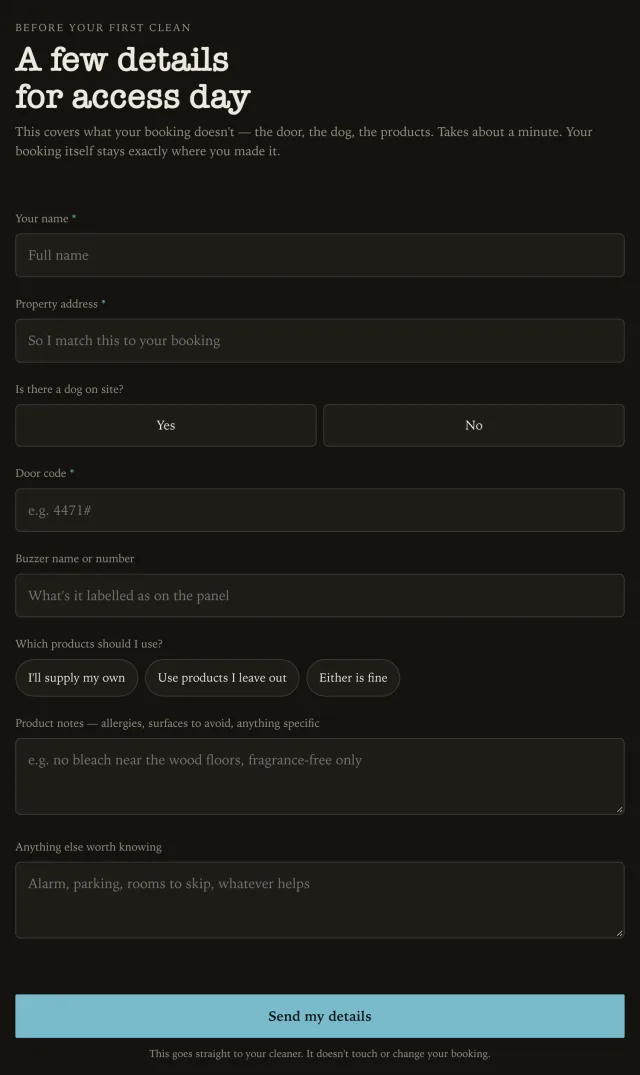
“A page my cleaning clients fill in once, for the things my booking system will not hold: which products to use, whether there is a dog, the door code, and which buzzer. They fill it in themselves and I read the answers. My bookings stay where they already are.”
A cleaner’s clients fill in what the booking software refused to hold — products, the dog, the door code — and the page says so at the bottom: it does not touch or change your booking. Answers go to the owner and are refused to everyone else.
Open the live appSaddle builds this from a description.
Write what you need in plain language, check the plan, and send the link. Your first app is free.
Questions
Do I have to move off the software I use now?
No, and that is the whole idea. Saddle builds the missing piece and gives you a link to it. Your booking system keeps the bookings; the companion app keeps whatever it refused to keep.
Can it read the data in my current tool?
No. Saddle apps do not connect to other software, so nothing syncs between the two. In practice the gap is usually information your current tool never held in the first place — there is nothing to sync, because it only ever lived in your head or in a notes field.
Isn’t this just another subscription?
Your first app is free and needs no card. After that it is $20 a month for as many apps as you want to publish — which is the comparison worth making, since the stack it sits next to is usually $120 or more.
What can it not do?
It cannot take a payment, send a push notification, or talk to another service. What it does is hold your own data, show it to the right person, and stay editable by you.
Other things people build with Saddle: see the list. Or check what it costs.